Wet Food vs. Dry Food: A Nutritional Comparison
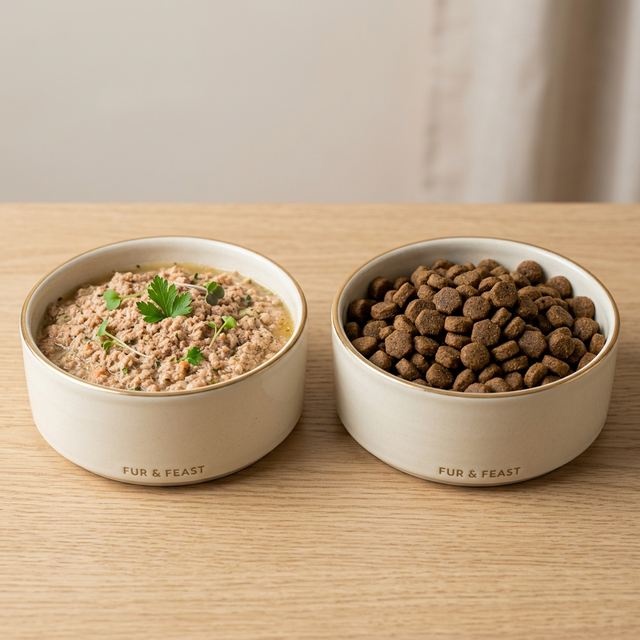
The wet-vs-dry debate isn't about which looks better in the bowl — it's about water content, caloric density, and what your individual pet actually needs. Here's the evidence.
PetFoodIQ Editorial Team
2026-03-06 · 5 min read
The Core Difference: Water
The single biggest difference between wet and dry pet food is moisture content:
| Format | Typical Moisture | Dry Matter |
|---|---|---|
| Wet/Canned food | 75–82% | 18–25% |
| Semi-moist | 25–35% | 65–75% |
| Dry kibble | 8–12% | 88–92% |
This matters enormously for comparison. A wet food that shows 10% protein on the label is not less nutritious than a dry food with 28% protein — once you convert both to a dry matter basis (DMB), they may be nutritionally equivalent or even reversed.
Use our Kibble Decoder to calculate dry matter basis automatically.
Dry Matter Basis: How to Compare Fairly
To compare two foods fairly, you must remove the water from both:
Formula: Nutrient% ÷ (100 − Moisture%) × 100 = DMB%
Example:
- Wet food label: 8% protein, 78% moisture → 8 ÷ 22 × 100 = 36.4% protein DMB
- Dry food label: 28% protein, 10% moisture → 28 ÷ 90 × 100 = 31.1% protein DMB
In this example, the wet food actually has more protein on a dry matter basis, despite looking lower on the label. Never compare as-fed percentages between foods with different moisture levels.
Nutritional Profile Comparison (DMB)
| Metric | Wet Food | Dry Kibble |
|---|---|---|
| Protein (typical) | 35–55% DMB | 25–35% DMB |
| Fat (typical) | 15–30% DMB | 10–20% DMB |
| Carbohydrate (typical) | 5–15% DMB | 30–50% DMB |
| Fiber | Low–Moderate | Moderate |
| Caloric density (kcal/g as-fed) | 0.7–1.1 kcal/g | 3.2–4.2 kcal/g |
Wet food tends to be higher in protein and fat, lower in carbohydrates on a dry matter basis. This is particularly relevant for cats, whose natural diet is very low in carbohydrates.
Hydration: The Most Important Advantage of Wet Food
Wet food contributes significantly to daily fluid intake. This is biologically important — especially for cats.
For Cats
Cats evolved from desert-dwelling ancestors with a naturally low thirst drive. They were designed to get most water from prey (which is ~70% water, similar to wet cat food). On a dry-food-only diet, many cats chronically under-drink:
- Urine specific gravity on dry food diet: Often above 1.050 (highly concentrated)
- On wet/mixed diet: Typically 1.020–1.035 (well-hydrated range)
Chronic dehydration is a major risk factor for:
- Feline idiopathic cystitis (FIC) and urinary crystals
- Chronic kidney disease (CKD) — the leading cause of death in cats over 10
For Dogs
Dogs regulate hydration more actively and will drink sufficient water if it is available. However, wet food can still benefit:
- Dogs with kidney disease or urinary stones
- Dogs that are poor water drinkers
- Hot climates or high-activity dogs with elevated water needs
Dental Health: Does Dry Food Clean Teeth?
This is one of the most widespread myths in pet nutrition.
The evidence: Most dry kibble provides minimal dental benefit. Teeth puncture through kibble on contact — the mechanical scraping action occurs only on the outermost layer, if at all. Studies show little difference in dental plaque accumulation between dogs fed wet vs. dry diets.
What actually works:
- Daily tooth brushing (most effective)
- VOHC (Veterinary Oral Health Council)-approved dental chews
- Water additives and dental diets specifically designed with special kibble shapes
- Enzymatic dental gels
Do not choose dry food over wet food for dental reasons unless the product carries a VOHC seal.
Cost Comparison
Wet food is significantly more expensive per calorie than dry food:
| Format | Typical Cost Per 1,000 kcal |
|---|---|
| Premium dry kibble | $2–6 |
| Mid-range wet/canned | $8–15 |
| Premium wet/canned | $15–30+ |
For many owners, feeding exclusively wet food is not financially feasible long-term. A mixed feeding approach (wet + dry) is common and nutritionally valid.
Mixed Feeding: The Practical Middle Ground
Feeding a combination of wet and dry has several advantages:
- Improved hydration over dry-only
- More palatable for picky eaters
- Lower cost than all-wet
- Variety in texture and sensory experience
Key caution: When mixing, ensure the total daily calories across both foods stay within the DER target. Many owners add wet food on top of a full dry food portion, leading to overfeeding.
Which Is Better for Specific Conditions?
| Condition | Recommendation |
|---|---|
| Urinary tract issues (cats) | Wet food strongly preferred |
| Chronic kidney disease | Wet food preferred (hydration + lower phosphorus options) |
| Weight management | Wet food can help (higher protein, lower calorie density as-fed, more filling) |
| Dental disease | Neither; use VOHC-approved dental products |
| Puppies/Kittens | Both appropriate; ensure AAFCO growth certification |
| Healthy adult dogs | Either, or mixed |
How to Evaluate Any Food (Wet or Dry)
- Convert all nutrients to dry matter basis before comparing
- Check for AAFCO complete and balanced statement and correct life stage
- Verify named protein source listed first
- For cats: prioritize taurine content and low carbohydrates
- Calculate caloric density: kcal/kg or kcal/can to manage portions accurately
FAQ
Can I switch between wet and dry food? Yes, gradually over 7–10 days to allow the digestive system to adjust. Sudden changes can cause diarrhea.
Does wet food spoil faster? Yes. Opened wet food should be refrigerated and used within 2–3 days. Dry food should be stored in an airtight container, away from heat and humidity.
Is grain-free wet food better? Not necessarily. Many cats and dogs thrive on grain-containing diets. The carbohydrate level matters more than whether the source is grain or legumes. See our article on the grain-free DCM controversy.
Advertisement