AAFCO Explained: What 'Complete and Balanced' Actually Means
The phrase 'complete and balanced' on a pet food label carries specific meaning — but it doesn't guarantee what most owners assume. Here's how to actually read it.
PetFoodIQ Editorial Team
2026-02-28 · 5 min read
What Is AAFCO?
The Association of American Feed Control Officials (AAFCO) is not a government agency and does not have regulatory enforcement authority. It is a voluntary membership organization of state and federal feed control officials from the US, Canada, and Costa Rica.
What AAFCO does:
- Develops model regulations for pet food labeling and ingredient definitions
- Publishes nutrient profiles — minimum (and some maximum) nutrient levels for dog and cat foods
- Defines the official ingredient terminology used on all US pet food labels
These model regulations are adopted — with variations — by individual US states. The FDA provides federal oversight for safety and labeling accuracy. AAFCO does not itself approve or certify any pet food.
What "Complete and Balanced" Means
When a pet food label states "complete and balanced", it means the manufacturer claims the food provides all the nutrients a pet needs for the stated life stage, at appropriate levels.
This claim must be substantiated in one of two ways:
Method 1: Nutrient Profile (Formulation Method)
The manufacturer calculates or analyzes the food to confirm it meets AAFCO's published minimum nutrient levels for the stated life stage.
- What it proves: The formula, on paper, meets the nutrient minimums at time of manufacture.
- What it doesn't prove: That the nutrients are actually bioavailable (absorbable by the animal), or that the food supports long-term health and appropriate growth/reproduction.
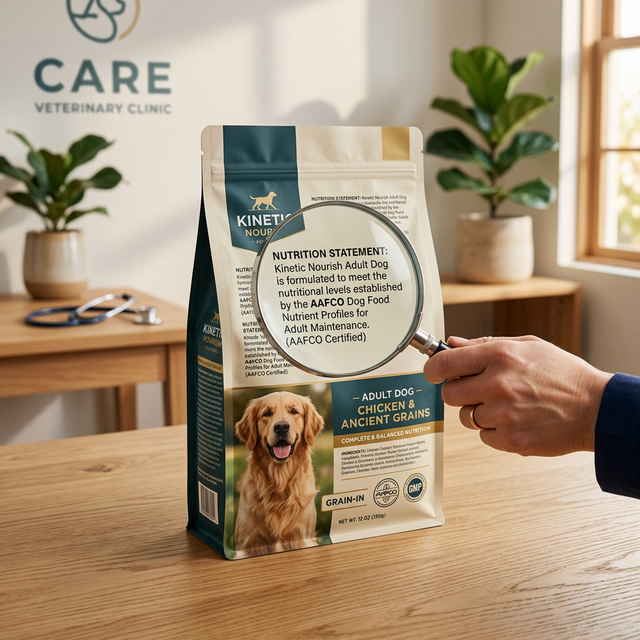
- Label language: "Formulated to meet the nutritional levels established by the AAFCO Dog (or Cat) Food Nutrient Profiles for [life stage]."
Method 2: AAFCO Feeding Trial
The manufacturer feeds the food to actual animals (minimum 8 animals per group) for at least 26 weeks (adult maintenance) or through specific growth/reproduction milestones, and measures health outcomes against AAFCO protocols.
- What it proves: The food demonstrably supports the health of real animals during a controlled trial.
- What it doesn't prove: Long-term (multi-year) effects; everything beyond the protocol endpoints.
- Label language: "Animal feeding tests using AAFCO procedures substantiate that [product] provides complete and balanced nutrition for [life stage]."
The feeding trial method is the more rigorous standard. It requires actual health data from animals eating the food, not just a calculation.
AAFCO Nutrient Profiles at a Glance
AAFCO publishes separate profiles for:
- Dogs: Adult Maintenance; Growth and Reproduction
- Cats: Adult Maintenance; Growth and Reproduction
Key Dog Nutrients (Minimum DMB)
| Nutrient | Adult Maintenance | Growth & Reproduction |
|---|---|---|
| Crude Protein | 18% | 22.5% |
| Crude Fat | 5.5% | 8.5% |
| Calcium | 0.5% | 1.2% |
| Phosphorus | 0.4% | 1.0% |
| Ca:P Ratio | 1:1–2:1 | 1:1–2:1 |
| DHA | Not specified | 0.05% (2023) |
Key Cat Nutrients (Minimum DMB)
| Nutrient | Adult Maintenance | Growth & Reproduction |
|---|---|---|
| Crude Protein | 26% | 30% |
| Crude Fat | 9% | 9% |
| Taurine (dry food) | 0.1% | 0.2% |
| Arginine | 1.04% | 1.25% |
| Niacin | 60 mg/kg | 60 mg/kg |
Life Stage Statements: Decoding the Label
| Label Statement | What It Means | Appropriate For |
|---|---|---|
| "Adult Maintenance" | Meets minimum needs for healthy adult pets | Adult dogs/cats only |
| "Growth and Reproduction" | Meets higher demands for puppies, kittens, pregnant/lactating females | Puppies, kittens, breeding |
| "All Life Stages" | Must meet the more demanding Growth and Reproduction profile | Any age — including puppies and seniors |
| "Senior" | No AAFCO standard exists for "senior" | Marketing term only — check actual life stage claim |
| "Complementary" (EU term) / "Treat" | NOT complete and balanced — intended as supplement only | Supplemental feeding only |
Important "Senior" note: There is no AAFCO nutrient profile for "senior" pets. Any food labeled "senior" must still claim one of the above life stages (usually "adult maintenance"). The "senior" label is purely a marketing designation with no regulatory backing.
What AAFCO Doesn't Guarantee
| What AAFCO Addresses | What AAFCO Doesn't Address |
|---|---|
| Minimum nutrient levels | Ingredient quality or source |
| Ingredient definitions (what "chicken meal" means) | Where ingredients come from |
| Basic safety standards | Long-term health outcomes beyond trial periods |
| Labeling accuracy | Manufacturing quality control frequency |
| Required statements | Heavy metal, mycotoxin, or contaminant testing frequency |
WSAVA Guidelines: Going Beyond AAFCO
The World Small Animal Veterinary Association (WSAVA) recognizes that AAFCO compliance is a minimum standard, not an optimal one. WSAVA's Global Nutrition Guidelines (updated 2021) recommend choosing manufacturers that:
- Employ a full-time board-certified veterinary nutritionist (ACVN diplomate or ECVCN) involved in formulation.
- Conduct and publish AAFCO feeding trials (not just formulation-based compliance).
- Perform and disclose nutrient analysis on finished product batches.
- Conduct quality control testing for contaminants, pathogens, and nutrient accuracy.
- Respond to owner inquiries with specific, detailed answers about nutrition and manufacturing.
WSAVA publishes a list of questions to ask pet food manufacturers. Companies that can't answer them are a red flag regardless of AAFCO compliance.
How to Evaluate a Food Label Step-by-Step
- Find the "complete and balanced" statement — is it there? If not, the food is a supplement/treat only.
- Check the life stage — does it match your pet's life stage?
- Feeding trial vs. formulation? — look for "animal feeding tests" language for stronger assurance.
- Guaranteed Analysis panel — use the Kibble Decoder to calculate DMB protein, fat, and carbohydrates.
- Contact the manufacturer — ask: Do you employ a full-time veterinary nutritionist? Do you conduct AAFCO feeding trials? Do you test finished product batches?
FAQ
Is AAFCO the same in every country? No. AAFCO is a North American organization. The EU uses FEDIAF (European Pet Food Industry Federation) standards, which are broadly similar but not identical. WSAVA recommendations apply globally.
Does AAFCO certification mean the food is safe? AAFCO compliance means the food meets minimum nutrient standards. It does not certify safety from contaminants, mycotoxins, or manufacturing errors. The 2007 melamine-contaminated pet food recall involved AAFCO-compliant foods.
What does "natural" mean on a pet food label? AAFCO defines "natural" as: a feed or ingredient derived solely from plant, animal, or mined sources, without chemically synthetic additives. It says nothing about nutritional quality, ingredient sourcing ethics, or processing methods.
Advertisement